The IRS requires you to report all side hustle income, but most gig workers leave money on the table by overlooking legitimate business deductions. These deductions reduce both your income tax bill and self-employment tax, which together can represent your largest tax liability as a side hustler.
Business deductions work by reducing your taxable income. If you earn $15,000 from freelancing but claim $3,000 in legitimate expenses, you only pay taxes on $12,000. For someone in the 22 percent tax bracket, that $3,000 deduction saves $660 in federal income tax alone. Self-employment tax savings add another 15.3 percent, for a total of roughly $1,000 in tax reduction on that same $3,000 in expenses.
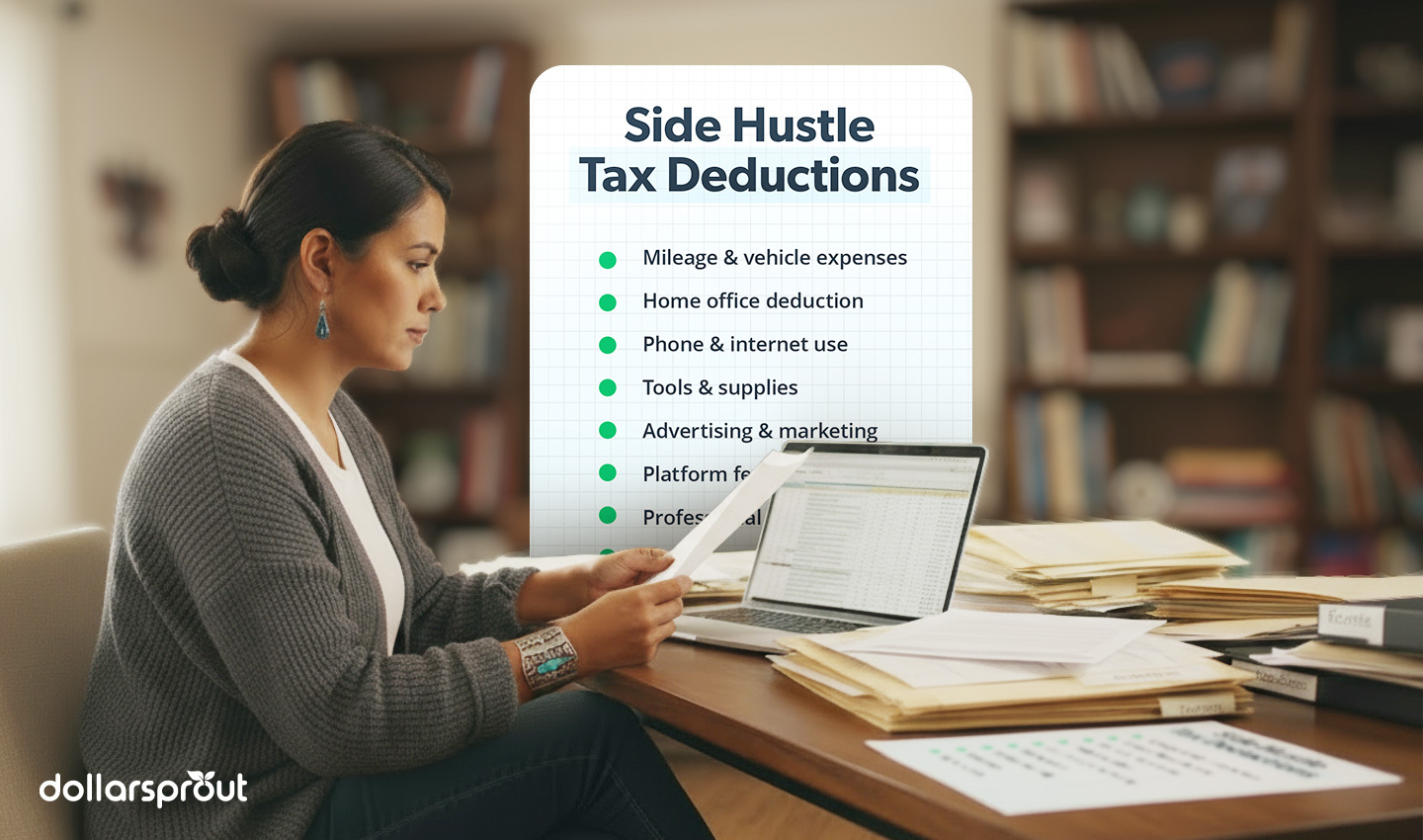
Common deductible expenses for side hustlers include home office costs (either actual expenses or the simplified IRS rate of $5 per square foot, capped at 300 square feet), internet and phone bills, software subscriptions, equipment purchases, supplies, mileage (59 cents per mile in 2025), meals related to business travel, and professional services like accounting help.
The key rule: expenses must be ordinary and necessary for your specific business. A freelance writer can deduct a laptop. A rideshare driver can deduct car maintenance and fuel. A reseller can deduct shipping costs and storage fees. The IRS scrutinizes deductions, so keep receipts and records for everything you claim.
Many side hustlers file Schedule C (Form 1040) when they earn over $400 annually from self-employment. This form lets you report income and expenses. Claiming zero deductions leaves you vulnerable to overpaying. Even claiming obvious deductions like mileage or a portion of utilities can reduce your tax bill significantly.
The 2025